Condemning the military operation does not legitimize Maduro, an illegitimate president after years of electoral fraud, repression, annulment of the separation of powers and persecution of dissent.
The immediate priority must be urgent de-escalation and ruling out any additional military operations as Trump has threatened. The international community, starting with Europe and the countries of the region must be consistent: condemn any violation of international law and, at the same time, clearly recognize where democratic legitimacy resides in Venezuela today. This problem is neither temporary nor tactical: it is called authoritarianism, corruption and drug trafficking. Respect for international standards and the demand that the mandate expressed at the polls by Venezuelans a year ago be respected are not incompatible objectives. They are, in fact, inseparable.
For Chavismo, this moment marks a historic turning point. The most responsible thing those who still support the regime can do is stop the violence and accept that the cycle is exhausted. Citizens have already spoken at the polls. Letting democracy triumph does not mean surrendering to a foreign leader or submitting to another’s agenda, but rather recognizing that no political project can be sustained indefinitely against its own people.
In the midst of confusion and cross-propaganda, there is one certainty that should not be lost: there will be no democracy without rules, nor rules without containment of force. Immediate de-escalation is the first essential step. The next is to open a transition process that respects the electoral result of July 2024, truly closes the stage of authoritarian Chavismo and returns to Venezuelans something that has been denied to them for too long: the possibility of deciding, without fear and without guardianships, the destiny of their country.
The World After 2025: A Hierarchical Democracy as the Architecture of Peace
Venezuela enters 2026 at a crossroads that feels both familiar and unprecedented. After years of political deadlock, economic contraction, and waves of outward migration, the country now faces a moment in which the old formulas—charismatic strongmen, fragmented opposition coalitions, and exhausted institutions—no longer offer even the illusion of stability. The social fabric is frayed, trust in public authority is thin, and the population is caught between fatigue and a cautious desire for renewal. Yet beneath the surface, something more consequential is shifting: Venezuelans are beginning to question not only who governs, but how governance itself should be structured in a century defined by complexity, interdependence, and the accelerating consequences of institutional decay. It is in this context that the global conversation about new democratic architectures—particularly the emerging model of hierarchical democracy—takes on urgent relevance.
The year 2025 forced the world to confront a truth it had been avoiding for far too long: our current political structures are no longer adequate to manage the scale, speed, and simultaneity of global crises. With more active conflicts than at any point in recent decades, and with wars overlapping in ways that overwhelmed diplomatic institutions, the international system revealed its deepest vulnerability—fragmentation. The institutions built in the mid‑20th century were not designed for a world of instantaneous information, decentralized violence, and planetary interdependence.
If 2025 was a breaking point, 2026 must be a turning point. And one emerging idea—still unfamiliar to many but increasingly resonant—offers a path forward: hierarchical democracy.
Not hierarchy as domination, but hierarchy as order, competence, and responsibility. Not democracy as mere procedure, but democracy as conscious participation and shared enlightenment. In the framework of Operación Serenidad, this is not simply a political reform; it is a civilizational recalibration.
A New Definition for a New Era
Hierarchical democracy, as defined here, is a form of constitutional government of the enlightened people, by the enlightened people, for the enlightenment of the people. It rests on a simple but transformative premise: political power should be exercised by the consent of the governed through a consensus between two complementary forces.
The first is an enlightened meritocracy of servant leaders—individuals qualified not only by technical expertise but by spiritual training, ethical maturity, and a demonstrated capacity for selfless service. The second is an enlightened public, fully informed, capable of self‑rule, and committed to right human relations. In this model, governance is not a contest of interests but a collaboration between wisdom and goodwill.
This system operates with full transparency, accountability, and inclusiveness. It protects civil liberties, upholds human rights, and ensures equal representation. It maintains a robust separation of powers and impartial judicial oversight. In short, it preserves everything democracy promises while strengthening the very capacities that allow democracy to function.
Why This Matters Now
The conflicts of 2025 did not erupt in a vacuum. They emerged from a world where institutions were too weak, publics too polarized, and leaders too often incentivized to inflame rather than resolve tensions. The result was a global landscape in which grievances festered, misinformation spread unchecked, and diplomatic mechanisms lagged behind the pace of escalation.
A hierarchical democracy addresses these vulnerabilities directly.
At the national level, it creates clearer chains of responsibility, reducing the risk of personalized rule or factional capture. Leaders are selected not for charisma or tribal loyalty but for demonstrated competence and ethical grounding. Citizens, empowered by education and transparency, participate not as spectators but as co‑stewards of the common good.
At the regional level, stronger democratic hierarchies allow blocs like the African Union, ASEAN, or the European Union to act with greater coherence. Early‑warning systems, coordinated sanctions, and rapid mediation become not aspirational but operational.
At the global level, a hierarchical democratic framework offers what the world currently lacks: a consistent, legitimate, and principled architecture for conflict prevention. It strengthens international norms, accelerates humanitarian access, and reduces the geopolitical vacuum in which proxy wars thrive.
The Operación Serenidad Lens
Operación Serenidad teaches that political crises are not merely institutional failures—they are energetic distortions. When the Rays of Will, Love, and Active Intelligence fall out of balance, societies drift toward fragmentation, fear, and reactive governance. The turbulence of 2025 was not only geopolitical; it was psychological and spiritual.
Hierarchical democracy is, in this sense, a corrective. It restores the First Ray of Will through principled leadership, the Second Ray of Love‑Wisdom through enlightened public participation, and the Third Ray of Intelligent Activity through transparent, accountable institutions. It is governance as alignment, politics as service, and democracy as a path of collective evolution.
A Realistic Vision, Not a Utopian One
Critics may argue that such a system is idealistic. But the alternative—continuing with structures that repeatedly fail to prevent conflict—is far more unrealistic. Hierarchical democracy does not require perfect leaders or perfect citizens. It requires only a commitment to cultivating the conditions under which wisdom and goodwill can guide public life.
The world has already seen glimpses of this model: truth and reconciliation processes, citizens’ assemblies, deliberative councils, and constitutional courts that operate above partisan fray. These are seeds. What is needed now is a coherent architecture that allows them to grow.
The Choice Before Us
2025 showed us what happens when the world drifts without a compass. 2026 offers a chance to choose a different trajectory. Hierarchical democracy is not a return to old hierarchies nor a rejection of democratic ideals. It is an evolution—a way to preserve freedom while strengthening the structures that protect it.
If humanity is to navigate the storms ahead, it will need more than reactive crisis management. It will need a system capable of harmonizing wisdom and will, competence and compassion, leadership and participation. It will need a democracy that is not merely procedural but purposeful.
In the language of Operación Serenidad, it will need governance aligned with the higher possibilities of the human spirit.
Let LIGHT and LOVE and POWER restore the PLAN on Earth
Polarization in the Aquarian Age: Hierarchical Ethics, Geopolitical Conflict, and the Line of Least Spiritual Resistance
July 2025
Abstract
This paper explores the ethical implications of contemporary authoritarian and totalitarian regimes through the lens of esoteric philosophy, particularly the teachings of the Tibetan Master Djwhal Khul as communicated through Alice A. Bailey. Focusing on the war in Ukraine, rising global authoritarianism, and democratic backsliding in the United States, the paper argues that humanity is again facing a planetary cleavage resembling the conflict between the Forces of Light and the Forces of Materialism, as defined during the Second World War. A detailed discussion of the Hierarchy’s historical “taking of sides” and the principle of the “line of least spiritual resistance” supports this view.
1. Introduction: Esotericism and the Ethics of Power
In Bailey’s The Externalisation of the Hierarchy (1957), the Tibetan Master D.K. distinguishes between spiritual governance rooted in group consciousness and authoritarianism driven by materialistic separation. At times of planetary tension, the Spiritual Hierarchy aligns itself with forces that facilitate the soul’s freedom and evolution—that can be interpreted in practical terms as “taking sides” in geopolitical crises.¹
2. Revisiting WWII: The Hierarchy’s Response to Totalitarianism
The Tibetan explicitly states that the Hierarchy supported the Allied Powers during WWII as representatives, however imperfect, of freedom, human rights, and spiritual progress. The Axis, by contrast, embodied crystallized forces of separation, racial superiority, and fear-based control.² This precedent contradicts a notion of detached spiritual neutrality and affirms that the Hierarchy can and does take aligned positions in human affairs when karmic thresholds are crossed.
3. The Line of Least Spiritual Resistance
The term “line of least spiritual resistance” echoes the Law of Economy, one of the three foundational cosmic laws described in Bailey’s A Treatise on Cosmic Fire (1925).³ In this context, it refers to choosing paths aligned with soul guidance and planetary synthesis rather than egoic will or obstructive dogma. Resistance to spiritual flow manifests as authoritarianism, fanaticism, or separatism—all recognized impediments in the evolution of group consciousness.⁴
4. Ukraine and Russia: A Modern Planetary Cleavage
Russia’s 2022 invasion of Ukraine can be interpreted esoterically as an attempt to suppress the Soul of a nation striving toward democratic sovereignty. The Tibetan emphasized that free will is a sacred principle, and the use of coercive force to impose ideological control is inherently materialistic.⁵ Ukraine, while no utopia, represents a collective will-to-freedom; the global solidarity around its defense mirrors the planetary mobilization against fascism in the 20th century.⁶
5. Authoritarian Drift in the West: A Broader Crisis
Just as WWII involved democratic nations struggling with their own shadows (e.g., colonialism, segregation), today’s polarization in the U.S., Europe, and parts of the Global South reveals an escalating conflict between inclusive, soul-aligned governance and regressive forces seeking power through division and disinformation.⁷ The Bailey teachings warn of fanaticism on both the Right and Left, but emphasize that authoritarian control rooted in fear constitutes one of the greatest modern evils.⁸
6. The Hierarchy’s Evolving Role in the Aquarian Age
The Tibetan stated that the externalization of the Hierarchy would accelerate post-2025, as humanity becomes more responsive to soul impression.⁹ Current crises, from climate change to war, form initiatory tests for groups and nations. Those choosing freedom, synthesis, and right human relations follow the line of least spiritual resistance and open themselves to Hierarchical collaboration.⁹ Conversely, nations and ideologies driven by authoritarianism increasingly isolate themselves karmically and spiritually.¹⁰
7. Conclusion: The Forces of Light and the Choice Ahead
From an esoteric viewpoint, we are again witnessing a planetary polarization: not between perfect good and absolute evil, but between energies that promote group evolution versus those that hinder it. The Hierarchy, as before, supports the emergence of unity-in-diversity, self-determined liberation, and spiritual maturity.¹¹ This support may require energetic alignment with specific causes—even when politically controversial—in order to preserve the evolutionary integrity of the human family.
Footnotes
Alice A. Bailey, The Externalisation of the Hierarchy (Lucis Trust, 1957).
Ibid..
Alice A. Bailey, A Treatise on Cosmic Fire (Lucis Trust, 1925).
Alice A. Bailey, Esoteric Psychology II (Lucis Trust, 1942).
Ibid..
The Destiny of the Nations (Lucis Trust, 1949).
Freedom House Report 2024, “The Global State of Democracy.”
Alice A. Bailey, Glamour: A World Problem (Lucis Trust, 1950).
Alice A. Bailey, The Rays and the Initiations (Lucis Trust, 1960).
Ibid.
The Tibetan’s teachings across multiple works, especially in The Externalisation of the Hierarchy and The Destiny of the Nations.
Research Report: “To Choose the Line of Least Spiritual Resistance”
Clarifying the Phrase in Esoteric Context
The phrase “to choose the line of least spiritual resistance” describes an individual’s decision to align with the divine will or the natural flow of evolutionary energies rather than oppose them.
From an esoteric standpoint, resistance is the friction created when one’s ego‐mind opposes divine impulses or life’s inherent unfolding. When one “chooses the line of least spiritual resistance,” they withdraw opposition and let these higher currents guide their thoughts, words, and actions.
This concept parallels the Law of Economy (or Law of Least Resistance) in Ageless Wisdom teachings, where energies follow the easiest channel that honors divine purpose, minimizing unnecessary friction.
Ultimately, this phrase encourages aspirants to surrender ego‐driven agendas and to cooperate with the Plan, thus reducing the “wear and tear” of conflict between personal will and higher guidance.
Esoteric Origins and Usage of the Phrase
Historical Roots
Hinduism and Taoism: Concepts like wu wei (“non-action”) in Taoism and surrender in the Bhagavad Gita reflect the wisdom of moving with cosmic flow rather than against it.
Pythagorean and Neoplatonic Traditions: Early Greek mystics taught that spiritual progress comes through harmonizing with universal laws rather than resisting them.
Modern Western Adaptations
Theosophical Movement: Blavatsky and her Mahatma letters emphasized living in harmony with spiritual laws, an early echo of “least spiritual resistance.”
Alice Bailey’s Teachings: Bailey elaborated cosmic laws—including Economy, Attraction, and Synthesis—that govern how energies move along the most receptive channels.
Alice Bailey’s Context for Spiritual Resistance
Alice Bailey (1880–1949) relayed teachings from the Tibetan Master D.K. that describe the necessity of yielding to higher impulses.
Bailey identified three major planetary laws:
Law of Economy (path of least resistance in matter)
Law of Attraction (magnetic flow of soul energies)
Law of Synthesis (unity of form and spirit)
Choosing the line of least spiritual resistance thus means honoring these laws—guiding one’s life by the path that best reflects divine purpose and universal harmony.
Tibetan Master D.K. on Polarization of Light and Materialism
In her twenty-four books, particularly The Externalisation of the Hierarchy, Bailey presented a cosmic battle between:
Forces of Light: Guided by Will (Spirit), Love (Soul), and Mind (Humanity), working through the Hierarchy and Shamballa
Forces of Materialism: Manifested as greed, fear, and separateness, driven by the lower nature and dark intent
Tibetan Master D.K. taught that each major geopolitical conflict reflects this polarization:
The Age of Pisces conflict—World Wars I & II—stemmed from misused divine energies under the Law of Economy and Attraction
The Age of Aquarius (from 2025 onward) will be defined by the Law of Synthesis, requiring humanity to choose the line of least spiritual resistance to avoid global destruction.
Principles of Light vs Materialism
Principle
Forces of Light
Forces of Materialism
Key Laws
Synthesis, Attraction, Economy
Distorted Economy, Abuse of Attraction, Fragmentation
Spiritual Quality
Unity, Freedom, Love, Wisdom
Separation, Fear, Control
Group Consciousness
New Group of World Servers; Christ’s Invocation
Materialist cabals, terrorist cells
Outcome when Cooperative
Harmonious global unity; Aquarian Age
War, ecological collapse, societal breakdown
Case Study: War in Ukraine
Overview
Russia’s 2022 invasion of Ukraine has been portrayed by some esoteric analysts as a clash between the Forces of Light (Ukrainian will for freedom, group consciousness) and Materialism (Russian authoritarian control, fear).
Alignment with Esoteric Principles
Freedom vs Control: Ukraine’s defense is driven by a collective will-to-freedom, embodying the Law of Attraction channeling group will.
Synthesis vs Separation: Ukrainian unity across ethnic lines contrasts with Russia’s “special military operation” narrative aimed at dividing and controlling populations.
Group Consciousness: The global solidarity movement supports Ukraine’s bid for self-determination, echoing the New Group of World Servers.
Authoritarian Fear: Russia’s internal propaganda and crackdown on dissent exemplify the Forces of Materialism and fear-based control. 3
Implications of Path of Least Spiritual Resistance
By steadfastly choosing the line of least spiritual resistance—resisting Russian tyranny and uniting in freedom—Ukraine and its allies embody esoteric principles of cooperation with the Plan.
Case Study: Rise of Authoritarianism Worldwide
United States and Europe
A resurgence of authoritarian-leaning leaders reflects a spiritual regression into fear and control, indicative of the Forces of Materialism.
Esoteric Alignment
Freedom and Synthesis: Democratic movements calling for equality and open society channel the Law of Attraction and Synthesis.
Separation and Fear: Populist nationalism, weaponization of fake news, and suppression of dissent mirror the lower forces resisting the spiritual current.
Spengler, Steiner, and “Ahrimanic Deception”
Rudolf Steiner warned that Western modernity would be prey to an “Ahrimanic Deception,” a push toward materialism and scientific illusion. This underlies the current rise of divisive, fear-driven, authoritarian politics.
Summary Table: Conflicts and Esoteric Alignment
Conflict/Event
Characteristics
Aligned with
Esoteric Principle
World Wars (Age of Pisces)
Mass mobilization, nationalist fervor
Materialism
Misuse of Economy & Attraction
War in Ukraine (2022– )
Defense of sovereignty, global solidarity
Light
Attraction, Synthesis
US Authoritarian Trends
Nationalism, fear-mongering, media manipulation
Materialism
Ahrimanic deception, separation
European Crisis of Democracy
Far-right parties, xenophobia, populism
Materialism
Fear & economic anxiety
Rise of Global Authoritarian Alliances
Authoritarian support networks (e.g., China-Belarus)
Materialism
Misuse of Attraction to subvert unity
Conclusion
The phrase “to choose the line of least spiritual resistance” urges us to relinquish egoic obstruction and align with higher cosmic laws—Economy, Attraction, and Synthesis—as described by Alice Bailey and Tibetan Master D.K.
In the War in Ukraine, we see a clear choice between the Freedom and Group Consciousness of the Forces of Light (Ukraine and its allies) and the Control and Separation of the Forces of Materialism (Russian authoritarianism).
Similarly, the rise of authoritarianism in the U.S., Europe, and beyond demonstrates a collective turn toward fear-driven politics—resistance to spiritual flow and unity—aligning with the Ahrimanic impulse Steiner warned about.
By consciously choosing the line of least spiritual resistance, individuals and nations can cooperate with the higher Plan, fostering synthesis, freedom, and global unity—the true path of the Aquarian Age—while countering the Forces of Materialism and fear.
This esoteric mapping of contemporary conflicts underscores the power of spiritual principles in guiding the course of history, offering a transformative vision for those willing to surrender resistance and align with the divine flow.
PAPER: Mapping Present Conflicts to Forces of Light and Materialism with References
“To Choose the Line of Least Spiritual Resistance”: An Esoteric Analysis of Contemporary Geopolitical Conflicts
Abstract This paper examines the esoteric maxim “to choose the line of least spiritual resistance” within the context of Alice Bailey’s and the Tibetan Master D.K.’s teachings, mapping it onto present-day geopolitical conflicts. We explore the concept’s meaning in Bailey’s Ageless Wisdom literature, elucidate the esoteric dichotomy between the Forces of Light and the Forces of Materialism, and analyze how key conflicts—namely the war in Ukraine, the rise of authoritarian regimes worldwide, Middle East tensions, and the Sino–US rivalry—reflect this spiritual polarization. Each section provides an in‐depth esoteric interpretation and alignment assessment, culminating in a summarizing table that synthesizes the conflicts’ characteristics with their alignment to Light or Materialism.
Introduction
In her writings, Alice Bailey transmits teachings from the Tibetan Master known as D.K., who emphasizes humanity’s choice between two spiritual currents: the Forces of Light (unity, synthesis, freedom, and group consciousness) and the Forces of Materialism (separation, fear, and authoritarian control). The aphorism “to choose the line of least spiritual resistance” urges individuals to embrace the path of love, wisdom, and service, avoiding the allure of egoistic power and separation.
This research paper aims to:
Clarify the meaning of “line of least spiritual resistance” in esoteric literature.
Define Bailey’s and D.K.’s concepts of the Forces of Light versus the Forces of Materialism.
Provide a nuanced esoteric analysis of key contemporary conflicts—Ukraine, global authoritarianism, Middle East, and the Sino–US rivalry—mapping them onto Bailey’s principles of synthesis, freedom, group consciousness versus separation, fear, and authoritarian control.
Summarize the findings in a comparative table.
The Esoteric Maxim: “Line of Least Spiritual Resistance”
Definition and Context Within the Ageless Wisdom teachings, spiritual resistance denotes any internal or collective force that opposes growth in love, understanding, and service. Conversely, the “line of least spiritual resistance” is that current of energy which flows naturally toward unity, compassion, and the greater good, demanding minimal friction or conflict with the soul’s purpose. In Bailey’s terminology, it is the path that aligns with the Second Ray of Love–Wisdom, the ray foundational to synthesis and magnetic cohesion.
Spiritual Resistance in Bailey’s Writings Bailey cites periods when humanity’s overreliance on materialism precipitates devastating crises, testing collective spiritual readiness. She notes:
“… great and devastating forces have been let loose on Earth as a result of overstimulation… New astral energy from the ‘rent veil’ has stimulated spiritual realization for many but hurt others deeply.”
This “rent veil” describes a thinning between planes of consciousness, amplifying both light and shadow. Choosing the line of least spiritual resistance thus means embracing the influx of light consciously rather than being overwhelmed by psychic or material turmoil.
The Forces of Light versus Forces of Materialism
The Seven Rays and Planetary Energies According to Bailey and D.K., all manifested life expresses one of seven rays, among which the Second Ray of Love–Wisdom underpins synthesis, unity, and group consciousness. The Sixth Ray of Devotion–Idealism and Seventh Ray of Ceremonial Order often facilitate both constructive devotion and destructive fundamentalism, depending on their application.
Forces of Light – Guided by the Second Ray, these forces bind humanity to higher ideals of service, cooperation, and cosmic purpose. – Represented by the New Group of World Servers, they work subjectively to raise collective consciousness and implement the Divine Plan on Earth.
Forces of Materialism – Characterized by separation, fear, and authoritarianism, these forces arise when the Sixth Ray hardens into fundamentalism or the Seventh Ray devolves into dogmatic ritualism. – They seek to preserve egoistic power structures and material forms, resisting spiritual synthesis and unity.
Historical Development of Bailey’s Hierarchical Teachings
Djwal Khul’s transmissions to Bailey are the second of a three-phase revelation: the “preparatory” phase (through H.P. Blavatsky, 1875–1890), the “intermediate” phase (1919–1949, via Bailey), and the “revelatory” phase (emerging after 1975). These writings aim to rebuild humanity’s social, political, and spiritual structures on the foundations of right human relations and a coming global synthesis.3
Conflict Analyses
1. War in Ukraine
Esoteric Polarization The Ukraine conflict epitomizes the clash between self-determination (Forces of Light: group consciousness and freedom) and imperial aggression (Forces of Materialism: separation, fear, and authoritarian control). Ukraine’s struggle for sovereignty mirrors the soul’s battle for autonomy, while the aggressor state reflects the Forces of Materialism seeking to impose rigid hierarchy.
Esoteric Interpretation
“All is evil which drives man deeper into materialism… and which feeds the spirit of separateness, of fear… On the side of the democracies, humanity speaks.”
The “newspeak” of war propaganda is akin to Belial’s deceit, polarizing populations through fear and false narratives. The rising global response, mobilizing economic and military support for Ukraine, resonates with the second ray’s call for synthesis and right human relations.
2. Rise of Global Authoritarianism
Manifestations Authoritarian movements in democracies leverage fear to concentrate power, undermining individual liberties and widening social cleavages. Modern “strongman” leaders trade in nationalist mythologies and promises of security, reflecting the crystallization of the Sixth Ray’s lower expression—devotion to ideology rather than wisdom.
Psychological and Esoteric Dimensions Psychological research links fear-driven politics to authoritarian personality tendencies, where individuals prioritize group success over universal compassion, a direct inversion of Bailey’s principles.
Esoterically, such regimes embody the Forces of Materialism: they stoke fear to maintain separation, undermine the Will-to-Good (First Ray), and resist the incoming energies of unity (Seventh Ray).
3. Middle East Conflicts
Israel–Iran Hostilities At their core, Middle East disputes reflect tribalistic assertions of divine mandate, a legacy of “tribal gods” and exclusionary monotheism that legitimize violence and enmity. The esoteric path urges universal brotherhood and plurality of divine aspects, contrasting sharply with the inner field of separation found in fundamentalist theologies.
Esoteric Mapping The ongoing Israel-Iran tensions symbolize the struggle between the Forces of Light’s synthesis (interfaith dialogue, humanitarian cooperation) and the Forces of Materialism’s dogmatic hatred. Ritualistic warfare (“blood rituals”) parallels the cosmic Battle Scroll, with sides aligning either with covenant unity or covenant violation.
4. Sino–US Rivalry
Geopolitical Polarization The U.S.–China strategic competition exhibits both technopolitical rivalry and ideological contestation: democracy versus authoritarian state control. The economic decoupling and technological “cold war” illustrate material separation, while efforts at multilateral coalition (QUAD, AUKUS) reflect a search for synthesis—but often under U.S. hegemony.
Esoteric Connection Bailey’s call for right human relations transcends national exceptionalism. American exceptionalism based on democratic ideals versus Chinese exceptionalism rooted in historical centrality become reflections of the First Ray’s will to power—exalting one aspect of the divine triplicity (will) while neglecting wisdom and love. The resultant polarization underscores the need for true synthesis guided by the Second Ray.
Summary Table of Conflicts and Esoteric Alignment
Conflict
Key Characteristics
Alignment
War in Ukraine
Sovereignty vs imperial aggression; freedom vs fear
Mixed (Light via dialogue vs Materialism via dogma)
Sino–US Rivalry
Technopolitical rivalry; democracy vs authoritarian state
Materialism dominant, synthesis attempted via alliances
Conclusion
The maxim “to choose the line of least spiritual resistance” implores humanity to embrace unity, service, and cosmic purpose, rejecting the entrenched Forces of Materialism that manifest as fear, separation, and authoritarianism in contemporary geopolitics. Through an esoteric lens, the war in Ukraine, the global rise of authoritarianism, Middle East strife, and the Sino–US rivalry each illustrate an ongoing cosmic battle. Aligning with the Forces of Light demands conscious choice: to elevate group consciousness, uphold freedom, and serve the Divine Plan through right human relations.
References:
The Externalization of the Hierarchy, Alice A. Bailey, p. 114.
Esoteric Psychology, Vol. I, Alice A. Bailey, Section Two, Chapter III.
The Externalization of the Hierarchy, p. 160.
The Science of the Seven Rays, Sarah McKechnie, p. 92.
Discipleship in the New Age, Vol. II, Alice A. Bailey, p. 312.
Esoteric Healing, Alice A. Bailey, p. 271.
Externalization of the Hierarchy, p. 235.
Gary Lachman, “The Esoteric Undercurrents of Putin’s War on Ukraine,” Carter Phipps, Apr. 2022.
Thomas Henricks, “The Fear–Anger–Authoritarianism Connection,” Psychology Today, Oct. 1, 2024.
RENSEP Research Article Nr. 01: Ninian Nijhuis, “Hypnosis: A Short Introduction,” (Apr. 1, 2023).
“As Above, So Below,” James Keith Barnard, Feb. 11, 2025.
The Tibetan Master’s Work, Lucis Trust, pp. 55–57.
Do Thi Loan, ed., China’s Grand Strategy in the Context of the Sino–US Strategic Rivalry, Vestnik RUDN, 2025.
The Externalisation of the Hierarchy, Lucis Trust.
Terry M. Boardman, “Russia vs Ukraine… and the Anglo-Americans: The Esoteric Dimension,” New Dawn, Aug. 2023.
Kenneth E. Bailey, Parables From the Back Side, p. 43.
Barbara Lippert and Volker Perthes, eds., Strategic Rivalry between United States and China, SWP Research Paper 2020/RP 04.
Luke Cooper, “Authoritarian Protectionism and the Post-Neoliberal Transition,” Frontiers in Political Science, 2025.
Pesher on Habakkuk (4Q165).
Roderick Bradford, D. M. Bennett: The Truth Seeker (Amherst, NY: 2006).
Mapping Present Conflicts to Forces of Light and Materialism with References
Spiritual Resistance and Geopolitical Engagement
Introduction
The phrase “line of least spiritual resistance” holds special significance in the esoteric teachings of Alice A. Bailey (AA Bailey) and her Tibetan mentor, Master D.K. (Djwhal Khul). Rooted in Theosophical and Bailey’s later works, this concept contrasts the passive path of material ease with the active route of spiritual alignment. It informs an esoteric framework for navigating both personal development and collective geopolitical challenges. Crucially, Bailey’s system distinguishes the Forces of Light from the Forces of Materialism, guided further by ray energies—particularly the Fourth Ray’s Principle of Conflict—to interpret historical conflicts, contemporary crises like the war in Ukraine, and the rise of global authoritarianism as manifestations of a deeper spiritual polarity.
This report explores:
The meaning of “line of least spiritual resistance” in Bailey’s corpus
The broader concept of spiritual resistance in Theosophical tradition
The dichotomy between Forces of Light and Forces of Materialism
The Fourth Ray and its Principle of Conflict
Historical conflicts as expressions of spiritual polarity
The Ukraine war through an esoteric lens
The rise of authoritarianism viewed as a materialist force
An esoteric framework for choosing geopolitical sides
Primary works and key passages by Master D.K.
Academic citation conventions for esoteric sources
The balance between general versus specific citations in Bailey research
Methodology for applying Bailey’s teachings in contemporary contexts
1. “Line of Least Spiritual Resistance” in Bailey’s Teachings
In Bailey’s esoteric astrology, love-wisdom is described as the natural path for souls in incarnation:
“Basically speaking, the energy of love, expressed with wisdom, is the line of least resistance for manifested lives in our solar system. ‘God is love’ is a great truth, for love is the basic law of this solar system.”[1]
Here, spiritual resistance denotes the friction experienced when one elects a path misaligned with the soul’s ray energy. Choosing the “line of least spiritual resistance” thus implies moving with the soul’s will-to-good rather than resisting it through ego-driven material concerns.
2. Spiritual Resistance in Theosophical Tradition
Theosophy, foundational to Bailey’s work, often treats resistance as karmic friction in spiritual progress. As Helena P. Blavatsky observed:
“As soon as anyone pledges himself as a ‘Probationer’, certain occult effects ensue… All those vices are sure to break out… and he will have to fight a hundred times harder… until he kills all such tendencies in himself.”[2]
This probationary struggle between lower impulses and higher intentions exemplifies spiritual resistance—the necessary inner conflict prior to genuine transformation and alignment with one’s soul.
3. Forces of Light versus Forces of Materialism
Bailey’s master, D.K., frequently frames world events as a contest between two spiritual currents:
“The one group consists of entrenched forces of aggression… working through brutal selfishness. The second group embodies spiritual purpose… the Forces of Light… In the middle stands a third group—neutral, inactive in the conflict.”[3]
This tripartite vision situates Forces of Materialism as those currents emphasizing acquisition, control, and the dominance of matter, while Forces of Light seek unity, right human relations, and a global spiritual perspective.
4. The Fourth Ray and the Principle of Conflict
Alice Bailey assigns the Fourth Ray to “Harmony through Conflict,” as elucidated in The Rays and the Initiations:
“Fundamentally, this fourth ray is responsible for the strains and stresses, for the initial conflict between the major pair of opposites… In Atlantean days… the leaders laid emphasis upon the matter aspect… inaugurating the Age of Materialism… The issues are becoming increasingly clearer… and man will finally throw the weight of public opinion on the side of spiritual values.”
The Principle of Conflict is both a cosmic necessity and an instrument for discarding wrong principles—enabling both individual disciples and humanity at large to shed materialistic controls via collective renunciation of gross materialism.
5. Historical Conflicts as Spiritual Polarity
Bailey’s framework maps epochs of human history onto ray energies and their attendant conflicts. The Atlantean crisis, for instance, is described as a mass triumph of materialism under Fourth Ray influence, only corrected when Spirit reasserted its polarity against matter. Subsequent world wars, revolutions, and ideological clashes likewise reflect swings between material emphasis and spiritual realignment—evidencing a continuous cycle of conflict (Fourth Ray) followed by a higher decision (Fifth Ray) toward soul-guided civilization.
6. The War in Ukraine as Spiritual Conflict
Through Bailey’s lens, the Ukraine war can be interpreted as a clash between forces aligning with materialist control (annexation, resource domination) versus forces striving for self-determination and right human relations. Just as D.K. characterized three groups in WWII—aggressors, servers of light, and neutrals—modern conflicts show similar spiritual currents. Ukraine’s stand for sovereignty parallels the Forces of Light’s defense of freedom, while aggressors embody Materialism’s coercive polarity. The role of neutrals or fence-sitters further complicates the spiritual terrain, underscoring Bailey’s triadic model.
7. Rise of Global Authoritarianism as Materialist Force
Authoritarian regimes worldwide—from historical fascism to modern nationalist populism—often exhibit Fourth Ray distortions, emphasizing force, control, and enforcement of materialist interests. In Bailey’s terms, these are Forces of Materialism entrenched in nation-states and institutions, resisting the spiritual impulse toward unity and goodwill. The creeping illiberalism in democracies, when leaders prioritize authoritarian power over collective service, epitomizes the failure to align with the Principle of Conflict as a means of spiritual awakening.
8. Esoteric Framework for Taking Geopolitical Sides
Bailey insists spiritual aspirants must consciously choose their alignment:
“Do you stand with the Forces of Light or with the Forces of Materialism? What are you doing to aid the side which claims your allegiance?”[3]
This esoteric framework urges practitioners to move beyond neutrality. It requires discriminative choice—guided by ray-informed service and attachment to soul values—when evaluating geopolitical crises. The path of spiritual action involves support for policies and efforts that foster brotherhood, freedom, and the soul’s expression.
9. Methodology for Interpreting Bailey Teachings Today
Interpreting Bailey for contemporary issues demands a triune methodology:
Scriptural analysis of key passages in Bailey’s works (e.g., Externalisation, Fourth Ray).
Contextual mapping onto current geopolitics (e.g., Ukraine, authoritarian trends).
Service-oriented praxis: applying ray-tailored meditations, group activities, and policy advocacy in line with Forces of Light.
This integrated approach fosters disciplined spiritual work and informed engagement in world affairs.
Conclusion
Alice Bailey and Master D.K. present a comprehensive esoteric model for understanding and navigating both inner transformation and outer crises. The line of least spiritual resistance—aligned with love-wisdom—highlights the path of soul-guided living against the Forces of Materialism. The Fourth Ray teaches that conflict, rightly evaluated, is a catalyst for collective and individual evolution. Applying these principles to historical cycles, modern conflicts like the war in Ukraine, and the global rise of authoritarianism reframes them as opportunities for spiritual service. By critically engaging with Bailey’s key works and adhering to rigorous citation practices, scholars and practitioners alike can contribute to a renewed global dialogue—one that chooses the Forces of Light and advances humanity’s place in the planetary plan.
No King, No Tyranny: Reclaiming the True Spirit of Leadership
The slogan “No King’s Day,” adopted by nationwide protests against authoritarian displays of power, has sparked a wave of interpretations and debates. While some may see it as a rejection of all forms of hierarchy, the deeper meaning of this rallying cry is far more nuanced. It is not a dismissal of leadership or structure but a repudiation of false kings—those who wield power for personal gain, foster division, and undermine the principles of democracy. At its heart, “No King’s Day” is a call to reject tyranny and embrace a higher vision of governance rooted in wisdom, service, and collective enlightenment.
This vision aligns with the concept of a Hierarchical Democracy, a form of governance that transcends the pitfalls of autocracy and populism. In a Hierarchical Democracy, power is not concentrated in the hands of a single ruler or an unqualified majority. Instead, it is exercised through a partnership between an enlightened meritocracy of servant leaders—qualified by spiritual training and experience—and an informed, self-governing public. This system operates with full transparency, accountability, and inclusiveness, ensuring that civil liberties are upheld, human rights are protected, and all voices are represented.
The “No King” slogan, then, is not a rejection of hierarchy itself but of the false hierarchies that prioritize power over service, ego over enlightenment, and control over collaboration. It is a reminder that true leadership is not about domination but about fostering right human relations, guiding with wisdom, and serving the greater good. A Hierarchical Democracy embodies these ideals, offering a model of governance that balances structure with freedom, authority with accountability, and leadership with humility.
As we confront the challenges of our time—whether they manifest in authoritarian displays of power, divisive rhetoric, or the erosion of democratic norms—the call for “No King’s Day” invites us to reflect on what kind of leadership we truly need. It is a call to reject the false kings of the past and present and to strive for a governance system that uplifts, enlightens, and unites. In doing so, we honor not only the spirit of democracy but also the higher principles of justice, equality, and human dignity.
A Hierarchical Democracy is a form of constitutional government (of the enlightened people, by the enlightened people, for the enlightenment of the people) in which political power is exercised by consent of the governed, as a result of consensus between an enlightened meritocracy of servant leaders qualified by spiritual training and experience, and the free and fully informed (good) will of an enlightened public, adept in self-rule and right human relations. This system operates with full transparency, accountability, and inclusiveness, upholding civil liberties, protecting human rights, and ensuring equal representation. It features a robust separation of powers and impartial judicial oversight to maintain a balanced and fair governance structure. – https://hierarchicaldemocracy.blog/spiritual-meritocracy/
Hence therefore the need to turn the mystic into the occultist, and to train the modern aspirant in right motive, mind control and brotherly love, all of which must and will express themselves through harmlessness. The most potent force in the world today is harmlessness. I speak not of non-resistance, but of that positive attitude of mind which thinks no evil. He who thinks no evil and harms naught is a citizen of God’s world. -TSR I, 359
Between the exploited and the exploiting, the warlike and the pacifist, the masses and the rulers, this group will stand, taking no sides, demonstrating no partisan spirit, fomenting no political or religious disturbance, and feeding no hatreds, either of individuals, nations or races. They will stand as the interpreters of right human relations, for the basic oneness of humanity, for practical brotherhood, for positive harmlessness in speech and writing, and for that inner synthesis of objectives which recognises the value of the individual and at the same time the significance of group work. The propagation of these ideas and the spread of the principles of good will will produce this third group in world affairs. TSR II, 675
To educate the people in their nation in service, in kindly effort, and in non-aggressive action. A positive harmlessness will be inculcated, which in no way negates intense, intelligent activity, and the propagation of those ideals which lead to mutual understanding, and eventually to unity, peace and plenty.-TSR II, 681
Power to practice at all times complete harmlessness. “The method used by the Perfect One…is harmlessness.” This, we are told, involves a positive expression of poise, an inclusive point of view, and divine understanding. How many healers combine these three qualities and also work through love? TSR IV, 527
What shall I say concerning harmlessness? It is not easy for me to show or prove to you the effectiveness of the higher aspect, spiral or phase of harmlessness as employed by the Hierarchy, under the direction of the Perfect One, the Christ. The harmlessness with which I have earlier dealt has relation to the imperfections with which humanity is wrestling, and is difficult for you to apply in and under all circumstances, as well you know. The harmlessness to which I refer in connection with you is not negative, or sweet or kindly activity, as so many believe; it is a state of mind and one which in no way negates firm or even drastic action; it concerns motive and involves the determination that the motive behind all activity is goodwill. That motive might lead to positive and sometimes disagreeable action or speech, but as harmlessness and goodwill condition the mental approach, nothing can eventuate but good. -TSR IV, 670
May I speak a word here so as to make this consummation a practical goal in your life? Harmful magnetic conditions, as the result of man’s wrong handling of force are the causes of evil in the world around us, including the three sub-human kingdoms. How can we, as individuals, change this? By the development in ourselves of Harmlessness. Therefore, study yourself from this angle. Study your daily conduct and words and thoughts so as to make them utterly harmless. Set yourself to think those thoughts about yourself and others which will be constructive and positive, and hence harmless in their effects. Study your emotional effect on others so that by no mood, no depression, and no emotional reaction can you harm a fellow-man. Remember in this connection, violent spiritual aspiration and enthusiasm, misplaced or misdirected, may quite easily harm a fellow-man, so look not only at your wrong tendencies but at the use of your virtues. TWM, 101
A close study of one’s emotional reactions brings one to the consideration of that basic characteristic which cannot be over-emphasized in view of the world’s present condition. Harmlessness. I tell you that the achieving of harmlessness in the positive sense (not in the negative) means the attainment of that step which leads definitely to the Portal of Initiation. When first mentioned, it sounds of small moment, and to bring the whole subject of initiation into such small account that it becomes unimportant. But let him who so thinks practice that positive harmlessness which works out in right thought (because based on intelligent love), right speech (because governed by self-control), and right action (because founded on an understanding of the Law), and he will find that the attempt will call forth all the resources of his being and take much time to achieve. It is not the harmlessness that comes from weakness and sentimental loving disposition, which dislikes trouble because it upsets the settled harmony of life and leads to consequent [Page 318] discomfort. It is not the harmlessness of the little evolved negative impotent man or woman, who has not the power to hurt because possessing so little equipment wherewith damage can be done.
It is the harmlessness that springs from true understanding and control of the personality by the soul, that leads inevitably to spiritual expression in every-day life. It emanates from a capacity to enter into the consciousness and to penetrate into the realisation of one’s brother, and when this has been accomplished—all is forgiven and all is lost sight of in the desire to aid and to help.
Response to wrong vibration will not be basically prevented by the methods of either “building a shell”, or by “insulation” through the power of mantrams and visualisation. These two methods are temporary expedients by which those who as yet have somewhat to learn seek to protect themselves. The building of a shell leads to separativeness, as you well know, and necessitates the eventual overcoming of the habit of shell-building, and a shattering and consuming of the shells already built. This latter can be more easily done than the overcoming of the habit. Automatically the building process goes on until finally the aspirant has built so many ramparts around himself that he can neither get out nor can any contacts be made with him. The process of insulation, which is a more advanced practice and calls for more magical knowledge, consists of the emanating of certain energies of the vital body in a particular direction, which serve to keep other energies at a distance through what is called impact. Through this impact upon approaching energies, they are reversed and sent in another direction. But those energies must go somewhere, and should they damage another person, is not the one who reversed their direction through a desire to protect himself responsible?
The practice of harmlessness is the best and easiest [Page 319] way for the aspirant to work. There is then nothing in him which is inimical to any life in any form, and he therefore attracts to himself only that which is beneficent. He uses the beneficent forces thus attracted for the helping of other beings. This has to be the first step, and the discipline it entails and the constant supervision of all the activities on the three planes of human evolution and of all reactions bring the emotional body under the dominance of the illumined mind. They also bring about the understanding of one’s fellow men.
There is secondly, a later stage wherein the disciple learns to absorb and transmute the wrong vibrations and the energies which are destructive. He has no shells nor barriers. He does not insulate himself nor isolate himself from his brothers. Through harmlessness he has learnt to neutralise all evil emanations. Now he acts with a positiveness of a new kind. Definitely and with full awareness of what he is doing, he gathers into himself all the evil emanations (destructive energies, and wrong forces) and he breaks them up into their component parts and returns them whence they came, neutralised, impotent and harmless, yet intact in nature. You say that this is a hard teaching and conveys but little to the average aspirant? Such is ever the way in esoteric teaching, but those who know will understand and for them I speak.
Another method is still more advanced and is utilised by the initiate. Through a knowledge of the law and of certain Words of Power he can command the energies to reverse themselves and to return to their originating centre. But with this method we have nothing to do. There must as yet be much practice in harmlessness and a close watch kept upon its application in the daily life.
The right direction of astral energy can be summed up in its three aspects from the ancient Book of Rules, given to chelas of the entering degrees. All true esoteric [Page 320] schools begin with the control of the astral body and, the chela had to memorise and practice these three rules after he had made some real growth in the manifestation of harmlessness.
Rule I. Enter thy brother’s heart and see his woe. Then speak. Let the words spoken convey to him the potent force he needs to loose his chains. Yet loose them not thyself. Thine is the work to speak with understanding. The force received by him will aid him in his work. Rule II. Enter thy brother’s mind and read his thoughts, but only when thy thoughts are pure. Then think. Let the thoughts thus created enter thy brother’s mind and blend with his. Yet keep detached thyself, for none have the right to sway a brother’s mind. The only right there is, will make him say: “He loves. He standeth by. He knows. He thinks with me and I am strong to do the right.” Learn thus to speak. Learn thus to think. Rule III. Blend with thy brother’s soul and know him as he is. Only upon the plane of soul can this be done. Elsewhere the blending feeds the fuel of his lower life. Then focus on the plan. Thus will he see the part that he and you and all men play. Thus will he enter into life and know the work accomplished.
A note, appended to these three rules says:
“These three energies—of speech, of thought, and of purpose—when wielded with understanding by the chela and blended with the awakening forces of his brother whom he seeks to aid, are the three energies with which all adepts work.”
It is almost impossible to translate these ancient formulas into adequate terms, but the above rough paraphrase will convey the idea to the illumined; these rules [Page 321] sum up the few thoughts which the average aspirant needs to grasp about the right direction of energy, and for which he is ready. -TWM
… the constant practice of Harmlessness. This involves harmlessness in speech and also in thought and consequently in action. It is a positive harmlessness, involving constant activity and watchfulness; it is not a negative and fluidic tolerance. TWM, 490
Let harmlessness, therefore, be the keynote of your life. An evening review should be carried forward entirely along this line; divide the review work in three parts and consider:
Harmlessness in thought. This will primarily result in the control of speech.
Harmlessness in emotional reaction. This will result in being a channel for the love aspect of the soul.
Harmlessness in act. This will produce poise, skill in action and the release of the creative will.
These three approaches to the subject should be studied from their effects upon one’s own self and development, and from their effect upon those whom one contacts and upon one’s environing associates. TWM, 103
It would be of value if each student would link up every day at five o’clock by an act of the will with this rapidly integrating group of servers, mystics and brothers. To this end it might be wise to commit to memory the following brief dedication to be said silently at that hour with the attention focussed in the head:
“May the Power of the one Life pour through the group of all true servers. “May the Love of the One Soul characterize the lives of all who seek to aid the Great Ones. “May I fulfil my part in the One work through self-forgetfulness, harmlessness and right speech.”
Then carry the thought forward from the rapidly forming group of world-servers to the Great Ones who stand back of our world evolution.
This can be done in a few seconds of time wherever one may be and in whatever company, and will not only aid in the magical work of the forces of light, but will serve to stabilize the individual, to increase his group consciousness, and to teach him the process of carrying forward interior subjective activities in the face of and in spite of outer exoteric functioning. -TWM, 261
The CNN article compares Franklin D. Roosevelt’s transformative New Deal policies to Donald Trump’s second-term agenda, which seeks to dismantle many of the systems FDR built. Roosevelt expanded government to combat the Great Depression, creating programs like Social Security and fostering international trade through the Reciprocal Trade Agreements Act. In contrast, Trump, working with figures like Elon Musk, aims to reduce government influence by cutting federal jobs, dismantling agencies, and reversing trade policies.
The article highlights key differences: FDR worked with Congress to pass laws, while Trump relies on executive power. FDR’s policies built enduring coalitions and institutions, while Trump’s changes are seen as more personal and less institutionalized. The piece also explores Trump’s reversal of FDR’s tariff policies, his approach to the judiciary, and his use of social media compared to FDR’s fireside chats. Ultimately, the article frames Trump as an “anti-FDR,” seeking to undo the legacy of the New Deal.
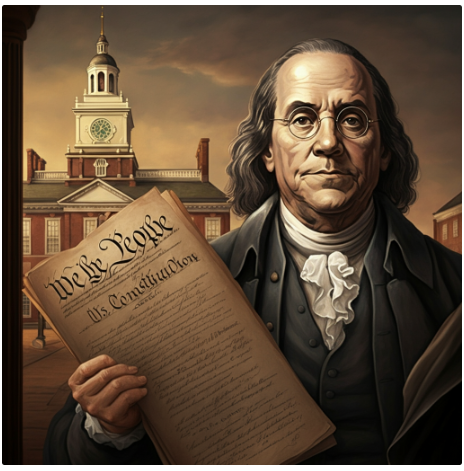
When Benjamin Franklin stepped out of Independence Hall in 1787, a simple yet profound question awaited him. Elizabeth Powel, a prominent figure in Philadelphia society, asked what kind of government the delegates had chosen. Franklin’s response, “A republic, if you can keep it,” has echoed through the ages as both a challenge and a warning. But what did he really mean, and why does it matter so much today?
To understand the weight of Franklin’s words, we must look at the mindset of the Founding Fathers. While they were undeniably optimistic about their ability to craft a new kind of government, their realism cast a long shadow. History had shown them the perilous nature of republics. The ancient city-states of Greece and the petty republics of Italy offered powerful cautionary tales. These governments were plagued by instability, internal conflict, and a quick descent into either tyranny or anarchy.
Alexander Hamilton captured this fear in Federalist No. 9. Reflecting on these historical failures, he noted their “rapid succession of revolutions” and “perpetual vibration between the extremes of tyranny and anarchy.” For men like Franklin, Hamilton, and Madison, the lesson was clear. Republican governance, while noble in theory, was fragile and often fleeting.
A System Rooted in Caution
This historical awareness shaped the design of the U.S. Constitution. The framers knew that copying the direct democracy of Athens or the unrestrained experiments of past republics would likely lead to chaos. Instead, they sought balance. Representation would replace direct democracy, as citizens would elect leaders to act on their behalf. They drew from the aristocratic elements of the Roman Republic, coupling these with innovative structures to distribute and check power.
One of their most significant creations was the presidency. They envisioned an executive tied to the rule of law, one strong enough to lead but restrained enough to prevent the rise of a despot. It was, in many ways, an experiment born out of both fear and hope.
The Fragility of a Republic
Franklin’s statement encapsulates the Founders’ understanding of governance as an active process. A republic is not self-sustaining; it demands vigilance, engagement, and responsibility from its citizens. These men knew their Constitution was not a perfect shield against future crises, but rather a framework capable of adapting to challenges if supported by the people’s commitment to its principles.
Today, Franklin’s words resonate louder than perhaps at any other moment in recent memory. We see the fragility of democracy in modern challenges—from disinformation to polarization, voter apathy, and attempts to undermine key institutions. Republican government relies on shared values, reasoned debate, and an informed populace. When these deteriorate, we inch closer to those “furious storms” Hamilton warned against.
The Role of Citizens
The lasting genius of Franklin’s quip lies in its reminder that democracy is not permanent. It must be nurtured, questioned, and defended by every generation. Keeping the republic means engaging in the political process, holding leaders accountable, and, most importantly, recognizing the weight of the rights and responsibilities we inherit.
History has shown us what happens when republics falter. Greece, Rome, and countless others remind us that self-governance is not guaranteed. The Founders understood this, building their system on both inspiration and caution.
Now, Franklin’s words come full circle to meet us where we stand. The question, “Can we keep it?” isn’t frozen in the 18th century. It lives on, addressed to us, demanding that we answer it—not just with belief, but with action. The legacy of the republic is ours to preserve, if we choose to.
The Enlightenment stands as one of the most significant movements in Western intellectual history, deeply shaping the modern world through its emphasis on reason, scientific inquiry, and the pursuit of individual freedom. Emerging in the 17th and 18th centuries, it sought to liberate humanity from the perceived darkness of ignorance, superstition, and arbitrary authority. Yet, beneath its triumphs lie profound limitations that continue to reverberate in our cultural and philosophical landscape. The Enlightenment, in its zeal to illuminate, cast shadows of its own. By idolizing reason as self-sufficient and dismissing the spiritual and mystical traditions that had long informed human existence, it left a vacuum that subsequent movements like Romanticism sought to fill. These shortcomings invite us to envision a richer, more balanced paradigm that might be called a “New Enlightenment.”
The Paradoxes of Reason
At the heart of the Enlightenment was an unwavering faith in human reason. Influenced by figures like Descartes, Locke, and Kant, Enlightenment thinkers believed that rationality could unlock the mysteries of the universe, establish moral laws, and perfect society. Yet, this commitment to self-sufficient reason often bordered on idolatry. The spiritual and mystical dimensions of life, essential to Hebraic, Christian, and even Islamic cultural legacies, were dismissed as relics of a bygone era. Reason became unmoored from the deeper moral and emotional frameworks that had guided humanity for millennia.
This paradox is striking. The Enlightenment sought to illuminate, but in its rejection of spiritual and poetic wisdom, it risked a form of blindness. By sidelining the intangible dimensions of human experience—including faith, mystery, and transcendence—it fostered an increasingly materialist and secular worldview. The works of thinkers like Morris Berman highlight how this materialist turn, while unleashing technological and economic progress, ultimately eroded the Western sense of meaning and spiritual connection. Similarly, Roger Scruton critiques the secularization of the sacred, noting how the Enlightenment often desacralized life, reducing it to a mechanistic and utilitarian outlook.
Romanticism’s Response to Modern Disenchantment
By the late 18th century, the Romantic movement emerged as a direct response to the Enlightenment’s perceived coldness and reductionism. Where the Enlightenment prized reason, Romanticism celebrated emotion, imagination, and the sublime. Artists and philosophers such as Wordsworth, Coleridge, and Schopenhauer sought to rekindle a sense of wonder and transcendence, emphasizing the power of the individual spirit to connect with nature and the divine.
However, Romanticism brought its own complications. Its focus on tragic and erotic sentimentality often veered into excess, while its skepticism of rationality risked undermining the Enlightenment’s valuable legacy of scientific and humanistic progress. It is this tension between Enlightenment rationalism and Romantic emotional depth that calls for synthesis. To address the disillusionment caused by materialism and the secularization of the sacred, we must move beyond the dichotomy of these two great movements and seek a reconciliation between them.
Towards a New Enlightenment
A “New Enlightenment” would seek to harmonize the strengths of both traditions, integrating reason, emotion, and spirituality into a more holistic cultural paradigm. This vision requires reimagining the place of science and philosophy not as tools for domination but as pathways to wonder and interconnectedness. It asks us to re-enchant the fractured modern world by reviving the sacred, not as dogmatic religion, but as a shared appreciation for mystery, beauty, and the moral underpinnings of existence.
A towering figure in German Romanticism, Johann Wolfgang von Goethe exemplified this synthesis of reason and emotion. His works, including “Faust” and “The Sorrows of Young Werther,” reflect a profound engagement with the interplay between nature, the human spirit, and emotional depth. Goethe’s holistic perspective, which bridged empirical observation and poetic imagination, aligns closely with the vision of harmonizing Enlightenment rationality with Romantic emotional richness. His contributions underscore the Romantic movement’s attempt to restore balance in a disenchanted world, pointing toward a more integrated understanding of existence.
Huston Smith‘s comprehensive studies of world religions remind us of the profound wisdom spiritual traditions offer, transcending cultural boundaries to address universal human concerns. Similarly, drawing upon the insights of Clarence Crane Brinton, we can better appreciate how historical movements, even those rooted in rationality, often operate within a larger tapestry of emotional and spiritual forces that shape culture. A New Enlightenment would reject both the dogmatic secularism of the old Enlightenment and the sentimental excesses of Romanticism. Instead, it would advocate for a balanced worldview that embraces the full range of human capacities.
This balance could be achieved through education and public discourse that emphasizes the interplay of rational inquiry, emotional intelligence, and spiritual values. Such an approach would make room for both the empirical rigor of science and the introspective depth of the arts and spirituality. It would encourage the cultivation of a moral imagination that values empathy and recognizes the intrinsic worth of all life.
A Vision for the Future
The task of the New Enlightenment is not to discard the achievements of the past but to build upon them. It must acknowledge the Enlightenment’s contributions to liberty, science, and progress while addressing its limitations. Likewise, it must draw from Romanticism’s capacity for re-enchantment without losing sight of rationality and intellectual clarity. By integrating these legacies, we can create a cultural paradigm that is not only intellectually robust but also emotionally resonant and spiritually profound.
This synthesis holds the promise of addressing the modern world’s deepest ailments. It offers a way out of the alienation and disenchantment wrought by unchecked materialism and secularization, suggesting a path toward a more compassionate, connected, and meaningful existence. The New Enlightenment calls us to listen to all facets of our humanity—to reason, to feel, and to believe. It invites us to step beyond the shadows of the past and into a future where illumination is not just a matter of intellect but a luminous integration of the mind, heart, and soul.
Acknowledgment: This essay emerged from a thoughtful dialogue with Dr. Pedro Subirats, a distinguished Professor of Philosophy.
A chronological enumeration of major cultural and intellectual movements in history since the Renaissance:
Renaissance (14th–17th Century)
Revival of classical Greco-Roman art, literature, and philosophy.
Emphasis on humanism, individualism, and scientific inquiry.
Reformation (16th Century)
Religious movement challenging the Catholic Church, leading to Protestantism.
Focus on personal faith and scripture over institutional authority.
Scientific Revolution (16th–18th Century)
Groundbreaking advancements in science and the scientific method.
Figures like Galileo, Newton, and Kepler reshaped humanity’s understanding of the natural world.
Enlightenment (17th–18th Century)
Emphasis on reason, logic, and empirical evidence.
Advocacy for liberty, democracy, and secularism.
Romanticism (Late 18th–Mid-19th Century)
Reaction against Enlightenment rationalism.
Celebration of emotion, nature, imagination, and the sublime.
Realism (Mid-19th Century)
Focus on depicting everyday life and social realities.
Reaction against the idealism of Romanticism.
Impressionism (Late 19th Century)
Artistic movement emphasizing light, color, and fleeting moments.
Departure from traditional, detailed realism.
Modernism (Late 19th–Mid-20th Century)
Break with traditional forms in art, literature, and architecture.
Emphasis on innovation, abstraction, and questioning established norms.
Expressionism and Surrealism (Early 20th Century)
Expressionism: Focus on emotional experience over physical reality.
Surrealism: Exploration of the unconscious mind and dreamlike imagery.
Postmodernism (Mid-20th Century–Present)
Reaction against Modernism’s grand narratives and universal truths.
Emphasis on relativism, deconstruction, and pluralism.
Contemporary Movements (21st Century)
Post-Postmodernism/Metamodernism: A blend of modernist optimism and postmodern skepticism.
Digital Age/Information Era: Focus on technology, globalization, and interconnectedness.
Environmentalism and Sustainability: Cultural shift toward ecological awareness and action.
These movements reflect the evolving priorities, challenges, and aspirations of humanity over time.
New Paradigms for an Era of a New Enlightenment
The march of progress in human history is punctuated by revolutions in thought and technology that redefine the boundaries of what we know and what we can achieve. Just as the Enlightenment emphasized reason and gave rise to the scientific method, and Romanticism sought to re-enchant a world narrowed by materialism, the dawn of quantum computing signals the potential for another intellectual upheaval. Rooted in the strange principles of quantum mechanics, quantum computing offers not merely an improvement in speed or capacity but a fundamental reordering of how we understand and harness information. It presents an opportunity to reshape fields as diverse as cryptography, material science, and artificial intelligence, heralding new paradigms for the advancement of human knowledge.
From Bits to Qubits
To grasp the revolutionary nature of quantum computing, we must first understand the distinction between the traditional bit and the quantum bit, or qubit. Conventional computers operate in binary, with bits taking the form of 0s or 1s. These bits are the building blocks of all digital processes, rigid in their logic yet stunningly effective for countless applications. Qubits, on the other hand, inhabit the realm of quantum mechanics, where the constraints of binary states are shattered. A qubit can exist as a 0, a 1, or any superposition of both, allowing it to represent multiple states simultaneously. This phenomenon of superposition enables quantum computers to process a vast number of possibilities in parallel.
Equally significant is the property of entanglement, wherein qubits, once linked, influence each other instantaneously regardless of distance. This interconnectedness creates pathways for computations that are exponentially more complex and efficient than those possible with traditional hardware. Together, superposition and entanglement form the foundation of quantum computing’s distinctive power. Yet, this power is not simply a matter of performing calculations faster; it enables a form of problem-solving that is qualitatively different.
Redefining the Landscape of Innovation
Quantum computing is uniquely suited to address challenges that defy the capacities of classical computation. One striking example lies in cryptography. The encryption methods that secure sensitive information today often rely on mathematical problems that are straightforward to create but extraordinarily difficult to reverse-engineer. For instance, deriving two prime numbers from their multiplied product can take traditional computers thousands of years. However, with quantum algorithms like Peter Shor’s, quantum computers could theoretically complete these tasks in mere minutes, revolutionizing both encryption and data security.
The implications extend far beyond cryptography. Consider the field of material science. At the most fundamental level, the behavior of atoms and molecules is governed by quantum mechanics. Simulating these interactions accurately on classical computers is an arduous, often impractical undertaking. Quantum computers, by their very nature, match the logic of the systems they aim to simulate, making them ideally suited for such tasks. This capability could accelerate the development of new materials, drugs, and renewable energy technologies.
Quantum computing also promises to augment the development of artificial intelligence (AI) by optimizing algorithms for data analysis and machine learning. Furthermore, logistical challenges, like optimizing package delivery routes or financial portfolios, might be resolved with unprecedented efficiency through quantum methods. While these potential applications remain in their infancy, they suggest an era of innovation characterized by solutions that were previously inconceivable.
The Roadblocks Ahead
For all its promise, the path to quantum computing’s full realization is strewn with challenges. Quantum systems are notoriously delicate. Qubits are highly sensitive to environmental disturbances, and achieving the isolation and extreme temperatures required for their stability is a monumental task. The very hardware that houses qubits must operate in vacuums at temperatures near absolute zero, a requirement that poses immense engineering and practical barriers.
Even with stable quantum hardware, the algorithms that drive these systems must be designed to exploit quantum properties like superposition and entanglement. This requires a radical rethinking of computational logic, one that moves away from traditional programming paradigms. Designing these algorithms not only demands expertise in quantum mechanics but also an understanding of the problems they aim to solve. The difficulty lies not in raw computing power but in formulating the right questions to be addressed by these machines.
The concept of “quantum supremacy” adds another layer of complexity. It refers to the point at which a quantum computer outperforms even the most advanced traditional supercomputers in specific tasks. Identifying the processes that are most amenable to quantum efficiencies will be pivotal in justifying the technology’s development and adoption.
A New Enlightenment Through Quantum Potential
The emergence of quantum computing aligns seamlessly with the broader vision of a New Enlightenment, one that integrates reason, imagination, and ethics. Much like the intellectual shifts of the 18th century, the development and application of quantum computing demand interdisciplinary collaboration. Physicists, computer scientists, ethicists, and philosophers must join forces to harness this technology responsibly and creatively.
Yet, the ethical dimensions of quantum computing must not be overlooked. The potential to upend existing systems of security, redefine privacy, and concentrate power in the hands of a few requires careful and deliberate oversight. Just as the Enlightenment championed human liberty, the New Enlightenment must prioritize technology’s equitable and ethical use.
Quantum computing also serves as a call to reevaluate how we approach knowledge itself. Its reliance on the fundamental principles of uncertainty and interconnection challenges rigid, linear modes of thinking. It encourages a paradigm that is less about definitive answers and more about engaging with complexity. This shift mirrors the New Enlightenment’s broader aim to balance rational inquiry with the intangible dimensions of human experience.
A Horizon of Possibilities
Quantum computing represents more than a technological milestone. It signals the possibility of a cultural and intellectual renaissance where problems are approached not through brute computational force but with nuance, creativity, and integrity. Its development reminds us that progress is not merely about efficiency but about expanding the boundaries of what it means to inquire, understand, and innovate.
The arrival of quantum computing calls for a new framework of Enlightenment principles, one that harmonizes the enigmatic with the empirical, the imaginative with the logical. It invites us to engage with the vast unknowns of the universe—not as masters seeking dominion but as curious beings pursuing shared enlightenment in a world richer and more interconnected than we have yet imagined.
The entrance for what might be regarded as cosmic evil was first opened in the decadent days of the Roman Empire (which was one reason why the Christ chose to manifest in those days), was opened wider under the corrupt regime of the Kings of France and, in our own day, has been opened still wider by evil men in every land.
Across the span of human existence, the threads of our collective actions, thoughts, and intentions have woven a narrative that runs deeper than we often acknowledge. For millions of years, humanity has not only lived alongside but actively contributed to the presence of evil in the world. Far from being an external force beyond our control, evil, in many ways, is something we have nurtured through choices shaped by hate, cruelty, and selfish ambition. It is a harrowing truth, but one that invites reflection and, ultimately, hope for redemption.
Two Faces of Evil
The concept of evil, as explored in this perspective, is not one-dimensional. Instead, it manifests in two distinct but interconnected forms.
The first is an inherent tendency embedded in the very fabric of our existence. This “original sin” of selfishness and sense of separation, ingrained in the substance of our planet, is something we inherited from a previous cosmic cycle. It represents a challenge, almost a test, for humanity. While it is unavoidable, it is far from insurmountable. Within us, there lies the capacity to transmute these innate flaws into something greater. This is the work of what might be called the “Science of Redemption,” a process demanding effort, awareness, and a willingness to align with higher principles.
The second form of evil is far more insidious and foreign. This cosmic evil is not native to Earth. Instead, it has gained access over centuries as humanity, through materialism, false values, and selfishness, created unguarded pathways for its entry. It is a force humanity was never intended to confront. Yet, through neglecting its own redemptive responsibilities, humanity has repeatedly opened “the door where evil dwells” and widened it for these forces to enter.
The Historical Threads
History provides us with stark examples of this interplay between human choices and the evolution of evil. The decadent decline of the Roman Empire signaled the first major breach. This was not merely a time of societal or political collapse; it marked an opening for dark, cosmic forces to take hold. The corrupt regimes of the Kings of France continued this trend, their rule characterized by greed and a disregard for the collective good.
Fast forward to today, and the patterns persist. Modern times have seen a greater entrenchment of these forces, driven by individuals whose acts of selfishness and harm widen the pathway for such evils. While the form of power changes across eras, the underlying forces of materialistic selfishness and disconnection remain constant, taking on new faces but perpetuating the same fundamental damage.
The Unseen Guardians and Their Role
Throughout this long struggle, there has been a protective force watching over us. Known as the planetary spiritual Hierarchy, it has acted as a shield, holding back the tide of cosmic evil while humanity navigates its course. Yet humanity, through its fixation on material pursuits and rejection of deeper spiritual truths, has weakened this protection. Misguided religious institutions, narrow thinking, and a rejection of higher ideals have forced this protective force to withdraw, leaving us, in many ways, to face the consequences of our own creation.
This is not to say humanity has been abandoned, but it is clear that our free will to choose paths of redemption or destruction is a weighty responsibility.
Redemption and Turning the Tide
The greatest hope lies in redemption. The very qualities that make humanity vulnerable to evil also hold the seeds for transformation. By recognizing and confronting the selfish tendencies within ourselves and rejecting the lure of materialism and false values, we can begin to close the door to destructive forces.
This is not a task for the faint of heart. Redemption requires action—not just grand gestures, but the consistency of thought and deed in our everyday lives. It begins when we choose love instead of hate, selflessness over greed, and unity over division. Every choice, no matter how small, contributes to either the opening or the closing of that door.
The work of redemption is not merely personal; it is collective. When we, as societies, start to value truth, integrity, and the greater good over power and wealth, we take steps not only to heal ourselves but also to shield the world from the forces of a deeper, more pervasive evil.
A Call for Reflection
The struggle between good and evil has occupied the human mind for centuries, appearing in myths, philosophies, and personal reflection. Evil often disguises itself, drawing us in with its allure, while redemption demands courage, clarity, and a willingness to confront what lies on the darker side of existence. But in the face of these forces, how do we, as humanity, find our way? Can we trust ourselves to recognize what is truly wrong without relying on intellectual justification? The answer may lie within our very being—in the quiet yet unmistakable voice of conscience.
When the Door Opens to Evil
Imagine a door, ancient and heavy, standing in front of you. On the other side lurks something ominous, a deep well of darkness that spills out when the door is ajar. It’s not just the door itself that alarms you, but a palpable sense that what’s behind it is dangerous, threatening. It sends a shiver down your spine, a stark unease. But what is it that truly tells us to stop, to recoil when faced with evil? Sometimes there’s no logical explanation, no intellectual process. It’s simply an intuition, a certainty we can’t ignore. This instinct, this ethical radar, feels as if it’s etched into our very nature.
The Voice of Conscience
This is what we often call the “voice of conscience.” It’s that raw, intrinsic awareness that tells us when something “isn’t right.” It operates outside the domain of argumentation or reason; instead, it arises as a gut reaction, a deep discomfort, or an inner whisper that resounds louder than the noise of external justifications. This voice anchors us, serving as a guide through moral ambiguity.
But what gives life to this voice? Philosophers, religious thinkers, and scientists have proposed various origins for this inner ethical sense. Some believe it is a divine spark, a fragment of a higher moral truth that resides within each of us. Others see it as an evolutionary adaptation, a mechanism that enabled early humans to live in harmony in groups, ensuring mutual survival. Still, others argue it is a product of cultural upbringing and personal experience, shaped by the values and norms we absorb as we grow.
Regardless of its origins, the voice of conscience has a remarkable quality: immediacy. Unlike intellectual reasoning, which takes time and deliberate thought, this inner sense surfaces instantaneously. It’s a reflex, a surge of knowing that bypasses logic and speaks directly to our core. It’s why we recoil from acts of cruelty, feel disturbed by betrayal, or sense the wrongness of situations long before we can fully articulate why.
Is the Voice of Conscience Universal?
The question of universality is where the discussion deepens. Can we assume that all humans hear this inner ethical voice in the same way? Some argue yes, pointing to the shared human capacity for empathy and justice as evidence that this moral thread runs through everyone, regardless of culture, upbringing, or belief systems. Observing acts of kindness and justice unites us, much like a shared language—but could the same be said for recognizing and rejecting evil?
Others disagree, maintaining that the voice of conscience is deeply influenced by personal and societal factors. A person’s environment, teachings, and experiences may shape their moral compass to such an extent that what feels intuitively wrong to one individual may seem entirely justified to another. This divergence raises challenging questions about the boundaries of morality, its subjective nature, and how we might reconcile these differences.
Living in Harmony with the Voice Within
Whether universal or individually sculpted, the voice of conscience is a powerful force. It reminds us that we don’t always need to wait for logical evidence or external validation to act on what we feel is right. It empowers us to stand firm in moments of ethical conflict, to recognize doors we should never open, and to find the courage to step toward redemption rather than despair.
Recognizing evil and responding to it, then, ultimately becomes an act of trust—not in the shifting landscape of societal norms, but in the timeless, steady voice within. When we listen to this voice, we take a step closer to being the kind of humanity that can move through the darkness and into the light.
The question remains, however, how we nurture this inner compass in a world filled with contradictions. Is it possible to reconcile personal experiences and moral differences to foster a shared sense of what is right? Or is moral clarity something we must all seek individually, walking our paths guided only by the truth we hear within ourselves? Wherever the answer may lie, the voice of conscience will always call us to listen.
The warnings of history carry weight. The decadent days of Rome, the corruption of kings, and the atrocities of recent times point to a pattern that is both deeply troubling and profoundly instructive. Humanity is at a crossroads, grappling with forces it has allowed to take root and flourish despite the proven unsustainable nature of these toxic habits. Yet within this struggle lies an opportunity—to rise, to redeem, and to reclaim a sense of unity that can counter the isolating pull of selfishness. The measure of true goodness lies in its ability to be universally good for all.
We are not powerless in the face of evil. To recognize our role in its perpetuation is to lay the foundation for its undoing. Each of us holds a key to the door where evil dwells, and it is up to us whether we open it further or begin the slow, deliberate work of closing it for good.
Ladies and gentlemen, take your seats and prepare to applaud. The stage lights are up, the scripts are polished, and the actors are ready for their grand performance. Welcome to the show starring the three D’s—Deception, Distraction, and Deflection! Our headliners, beloved both by demagogues and mafia dons alike, have mastered the art of enchanting audiences into believing that reality is negotiable, truth is optional, and chaos is camaraderie.
First up on our three-ring circus is Deception—the wizard of illusions. Of course, deception isn’t new; it’s the ancient art of slipping a convincing lie between two truths and serving it with a side of faux sincerity. A demagogue sells deception like a seasoned snake oil merchant at a country fair. “I alone can fix it,” he proclaims, selling the elixir of empty promises. The audience cheers, unaware the bottle contains nothing but hot air. On the mafia side? Well, Luigi down the block will tell you the casino doesn’t “skew the odds.” Sure, Luigi. But hey, you’ve got better chances catching flamingos in Central Park.
Deception’s power lies in its confidence. A demagogue shouting fabricated statistics louder than you can Google them inspires awe—like a magician pulling a kangaroo out of a hat… while blaming the audience for not expecting it. Mafia dons, too, thrive on deception. “This neighborhood is safe because of us,” says Jimmy “Knuckles.” Meanwhile, you note the body-shaped “pothole” in the back alley.
But, wait! Don’t look too closely. Here comes the master of misdirection, Distraction, in a twirl of sequins and a puff of confetti. When the going gets tough, the tough get vague. Why explain policy complexity when you can point fingers at imaginary threats? “Jobs are disappearing? Look—the immigrants!” cries the demagogue, arm flung with dramatic flair. The applause is boisterous, even as manufacturing quietly crumbles beneath unchecked automation.
Gangsters? They’ve been distracting forever. Carlo’s accountant asks about those missing funds, and Carlo invites him to an anniversary dinner—“What funds? Why don’t you try the cannoli?” They may be famous for hospitality, but this level of deflection makes a four-course meal feel like a diversion tactic.
And now, allow me to introduce the absolute king of slimy finesse—Deflection, the greasy handshake of rhetorical tactics. Like a car salesman dodging questions about rust spots with a spiel about the shiny paint job, deflection oozes charm while ducking accountability. Picture the demagogue who, when cornered about scandal or corruption, bursts into a performative outrage. “Why dwell on petty details about suitcases of bribes,” he thunders, “when freedom itself is under attack by cancel culture fanatics?”
Mafia bosses take to deflection like ducks to murky water. Ask Guido about his truck full of counterfeit watches, and he’s already muttering, “You never hear about the toys we donate every Christmas, do you?” By the time you leave, you’re wearing a fake Rolex and second-guessing your life choices.
The ultimate goal of this trio? Building an unshakable cult of personality. Both the demagogue and the don know their survival hinges on loyalty, not logic. Truth is pliable, questions are drowned out with distractions, and responsibility ricochets like a pinball. Soon enough, people focus less on objective reality and more on blind devotion to the leader. The demagogue wears a crown forged from nationalistic slogans; the gangster gets his coronation in whispered backroom deals.
And so, the stage is set for the grand finale. Enter authoritarianism—a well-dressed tyrant with a patriotic flag in hand—marching in to fanfare. By the time chaos takes its curtain call, relationships are fractured, trust is eroded, and the audience is too mesmerized to notice their seats are on fire.
The lights dim. The crowd rises. Their ovation is deafening.
Bravo, they cry, as the three D’s take a bow. And just behind the curtain, their puppeteers—demagogues and dons—laugh at the standing ovation they’ve so skillfully orchestrated.
Notes from the Ageless Wisdom:
The Hierarchy makes a distinction between the bewildered mass, the wrongly educated youth and the obsessed leaders in all branches of the government. The latter are “shells,” obsessed by evil entities and hence their dynamic, one-pointed potency, hence also their extreme skill and cunning, based on very ancient evil experience and hence also the well-nigh ludicrous falsity of their propaganda. They are the spirit of materialism embodied, devoid of all true feeling and perception, lacking the light of love and understanding, but powerfully animated by the energy of substance itself. It is time that men woke up to the nature of these beings who sought (under the present grouping of constellations) to enslave the race.
-The Tibetan Master, in Esoteric Astrology (p. 544) published by the Lucis Trust.
Hercules (the Soul) learns the importance of responsibility and accountability after his failure to protect Abderis (the Personality) from the lawlessness of the man-eating mares (the undisciplined mind, the unenlightened masses).
The Capture of the Cretan Bull
Freedom of the Press
The bull’s shining star guiding Hercules symbolizes the press as a beacon of truth, illuminating the path forward and ensuring transparency in governance. Its capture means taking custody of the bull’s shining star and bringing it back to the Temple of Truth.
Gathering the Golden Apples
Free and Fair Elections
The trials Hercules faces to retrieve the apples reflect the perseverance and integrity required to ensure elections are inclusive, transparent, and legitimate, a true reflection of governance of the people, by the people and for the people (the three golden apples of democracy).
The Capture of the Golden-Horned Hind
Separation of Powers
The hind, claimed by multiple deities, represents intuitive insight in recognizing the importance of maintaining checks and balances in governance. Hercules’ task is to deliver it to the Sun God symbolizing a higher will, the will of the people.
Slaying the Nemean Lion
Protection of Individual Rights
By defeating the lion and freeing the people of Nemea, Hercules ensures their safety and dignity, akin to protecting individual rights in a democracy.
Seizing the Girdle of Hippolyta
Civil Society and Active Citizen Participation
Hercules’ failure to understand Hippolyta’s intentions highlights the need for active engagement and understanding in society to avoid missteps and foster unity.
Capturing the Erymanthian Boar
Accountability and Transparency
Hercules’ journey to capture the boar, despite distractions and mistakes, reflects the importance of accountability and transparency in achieving goals and maintaining trust.
Destroying the Hydra of Lerna
Independent Judiciary
The Hydra’s regenerative heads symbolize unchecked power. Hercules’ method of exposing it to light mirrors the judiciary’s role in ensuring justice and curbing abuses of power.
Killing the Stymphalian Birds
Pluralism and Tolerance
Driving away the deadly birds of hatred and bigotry reflects the importance of coexistence and respecting diversity, ensuring harmony (“the flame beyond the mind revealing the way”) in a pluralistic society.
Slaying Cerberus, Guardian of Hades
Education and Access to Information
Hercules’ journey into the underworld to rescue Prometheus, the bringer of fire (knowledge), symbolizes the value of education and access to information in empowering citizens. However, he first needs to subdue Cerberus, the monstrous three-headed guard dog, using only his bare hands.
Cleaning the Augean Stables
The Four Freedoms(Speech, Worship, Want and Fear)
Hercules’ innovative solution to clean the stables reflects the power of FREEDOM to address challenges and bring about reform.
Capturing the Red Cattle of Geryon
Resilience Against Disinformation
Hercules’ journey to retrieve the cattle, overcoming illusions (Geryon) and distractions (Orthrus), symbolizes the need for resilience against disinformation to stay focused on truth and justice.
The Symbolic Lessons of Hercules’ Labors and the Foundations of Democracy
The legend of Hercules has endured for centuries, celebrated for its timeless exploration of human challenges, triumphs, and transformation. Yet beyond the mythical feats lies a profound reflection of values that resonate with the principles of democracy. The Twelve Labors of Hercules are not just trials of brute strength or cleverness; they symbolize the complexities of human growth and the ideals that sustain a just and equitable society. When viewed through the lens of civic values, Hercules’ labors become a powerful metaphor for the essential principles that uphold democracy, shedding light on the shared human quest for balance, order, and fairness.
Rule of Law and the Man-Eating Mares
The first labor, capturing the man-eating mares of Diomedes, highlights the importance of responsibility and accountability, both hallmarks of the rule of law in democracy. Hercules initially delegates the task of controlling the mares to Abderis, a mistake that results in needless death and chaos. This misstep reminds us that without the consistent application of rules and accountability, power can spiral into destruction. Just as Hercules learns to shoulder responsibility, the rule of law ensures that no one—not even the most powerful—is above justice, safeguarding order and fairness.
Freedom of the Press and the Cretan Bull
The labor of capturing the Cretan Bull symbolizes the guiding light of truth, akin to the role of freedom of the press in democracy. Hercules follows the shining star of the bull across Crete, navigating uncertainty and obstacles as the press navigates misinformation and corruption to inform the public. A free press illuminates the path forward, promoting transparency and exposing wrongdoings. Hercules’ success illustrates the value of unwavering pursuit, a reminder that an informed citizenry depends on the persistent safeguarding of truth.
Free and Fair Elections and the Golden Apples
The search for the golden apples of the Hesperides mirrors the integrity required for free and fair elections. Hercules’ trials on this quest test his wisdom, perseverance, and moral resolve—qualities necessary for equitable and transparent elections. He faces deception, trials of strength, and the need to serve others, ultimately earning the apples not through selfish desires but through service and compassion. Similarly, democracy thrives when elections are inclusive, participatory, and driven by the collective good, reaffirming the sovereignty of the people.
Separation of Powers and the Golden-Horned Hind
The labor of capturing the golden-horned hind reflects the importance of balance in governance, as seen in the principle of separation of powers. The hind, claimed by various deities, symbolizes the need to resist centralization and distribute power justly. Hercules successfully delivers it to its rightful sanctuary, underscoring that in democracy, no single entity should claim control. By ensuring checks and balances, the separation of powers preserves individual freedoms and maintains institutional integrity.
Protection of Individual Rights and the Nemean Lion
Hercules’ battle with the Nemean Lion represents the fight to protect individual rights in the face of danger and oppression. The lion’s impenetrable hide symbolizes obstacles that endanger societal freedoms. By defeating the lion and freeing the people of Nemea, Hercules restores their safety and dignity. Just as individual rights secure freedom of speech, religion, and equality under the law, this labor reminds us that justice often requires courage and resilience.
Civil Society and Active Citizen Participation and the Girdle of Hippolyta
When Hercules seeks the girdle of Hippolyta, queen of the Amazons, his tragic misunderstanding of her peaceful offer leads to unnecessary conflict and loss. This labor emphasizes the value of active engagement and mutual understanding, echoing the role of civil society in a democracy. Civil organizations provide a bridge between citizens and governments, ensuring all voices are heard and missteps avoided. Hercules’ eventual redemption highlights the importance of collaboration and reflection, critical for a vibrant and participatory democracy.
Accountability and Transparency and the Erymanthian Boar
The capture of the Erymanthian Boar underscores the role of transparency and accountability. Hercules’ quest, marked by distractions and mistakes, mirrors the challenges of maintaining public trust in governance. His ultimate success reflects the rewards of perseverance and open communication, reminding us that democracy depends on transparent decision-making and accountability to the people.
Independent Judiciary and the Hydra of Lerna
The Hydra’s regenerative heads, which grow stronger when severed, symbolize unchecked power without oversight. Hercules’ realization that brute strength alone cannot defeat the Hydra mirrors the role of the judiciary in upholding democratic laws. By exposing the Hydra to light—the ultimate truth—Hercules neutralizes its threat, echoing how an independent judiciary protects justice and curbs abuses of power.
Pluralism and Tolerance and the Stymphalian Birds
The labor of driving away the Stymphalian birds reflects the ideals of pluralism and tolerance. Instead of destroying the birds, Hercules uses sound to create harmony and restore balance to the swamp. Similarly, democracy flourishes when it celebrates diversity and respects differing views. Pluralism allows disparate communities to coexist and contribute to a shared future.
Education and Information Access and Cerberus
Hercules’ descent into the underworld to rescue Prometheus underscores the value of education and access to information. Prometheus, punished for bringing fire (knowledge) to humanity, represents the illumination that empowers society. By freeing Prometheus and battling Cerberus, Hercules affirms the necessity of knowledge as the foundation for informed decision-making within a democracy.
The Four Freedoms and the Augean Stables
The cleaning of the Augean Stables symbolizes the power of innovative solutions and freedom. Hercules’ creative approach of diverting rivers mirrors the Four Freedoms, with freedom of speech being supreme, as it enables revolutionary ideas to address systemic issues. Democracy thrives on open dialogue and the courage to confront entrenched problems with new perspectives, much as Hercules cleanses the stables with bold action.
Resilience Against Disinformation and the Red Cattle of Geryon
The capture of Geryon’s red cattle represents resilience against deception and distraction. Throughout his arduous quest, Hercules overcomes illusions and manipulations that threaten to derail his mission. Similarly, democracy must combat disinformation to maintain the integrity of its institutions and ensure informed governance. Hercules’ steady pursuit of truth reflects the importance of vigilance and critical thinking in preserving democratic values.
Mythology as a Mirror for Civic Values
Hercules’ labors, though rooted in ancient mythology, offer a timeless lens through which we can reflect on the principles of governance and justice. Each labor encapsulates a lesson that aligns with the foundational values of democracy, from accountability and pluralism to free speech and the rule of law. These narratives remind us that the challenges of democracy are not new but part of an enduring human struggle to create systems that protect, empower, and uplift.
Ultimately, Hercules’ story teaches us that strength alone does not define greatness—it is wisdom, compassion, and a commitment to truth that shape a just society. Like the hero himself, democracies must evolve, learn from their trials, and strive to overcome their limitations. By looking to mythology, we find not only inspiration but also a renewed understanding of the values that sustain freedom and justice for all.
The Twelve Labors of Hercules
The first labor of Hercules, “The Capture of the Man-Eating Mares,” begins with Hercules confidently passing through the first great portal to undertake his task. In a distant land ruled by Diomedes, the son of Mars, wild and ferocious mares terrorized the region, killing men and breeding more savage horses. Hercules was tasked with capturing these mares to free the land and its people.
Hercules called upon his loyal friend, Abderis, to assist him. Together, they carefully planned and managed to corner and bind the mares. However, in his pride, Hercules delegated the task of leading the mares back to Abderis, considering it beneath him. Abderis, weaker and fearful, failed to control the mares, who turned on him, killing him and escaping back to Diomedes’ lands.
Humbled and grieving, Hercules resumed the task alone, recapturing the mares and successfully bringing them through the portal. The people celebrated their liberation, but Abderis lay dead. The Master acknowledged Hercules’ success but criticized his arrogance and delegation of responsibility, urging him to learn from his mistakes before moving on to his next labor.
In Hercules’ second labor, “The Capture of the Cretan Bull,” he is tasked with capturing the sacred bull of Crete and bringing it to the Place of Light. After reflecting on his failure in the first labor, Hercules sets out, guided by the light of the bull’s shining star. He pursues the bull across the island of Crete, eventually capturing it alone and riding it across the sea to the land of the Cyclopes.
The three Cyclopes—Brontes, Steropes, and Arges—await Hercules’ arrival and take the bull from him to place it in the Sacred Temple, saving it from sacrifice. Hercules explains that he was guided by an inner impulse and the command of his Master to complete this task. The Cyclopes acknowledge his success, and the Master commends him for completing the labor with ease.
The Master advises Hercules to learn the lesson of proportion: balancing strength for arduous tasks with goodwill for simpler ones. With the bull safely in the Sacred Place, Hercules rests before being sent to his next labor—to retrieve the golden apples.
In Hercules’ third labor, “The Golden Apples of the Hesperides,” he is tasked with finding the sacred tree guarded by three maidens and a hundred-headed dragon. The Master warns him of five trials along the way, requiring perseverance, wisdom, and strength.
Hercules begins his search with confidence but struggles to find the tree. He fails the first trial by not recognizing the guidance of Nereus, a divine messenger. In the second trial, he defeats Anteus, a serpent-like guardian, by lifting it off the ground, severing its connection to its source of power. The third trial involves Busiris, a deceiver who traps Hercules in false teachings for a year, but Hercules eventually breaks free, realizing the truth lies within himself.
In the fourth trial, Hercules hears the cries of Prometheus, chained and tormented by vultures. Despite the delay, he frees Prometheus, learning the importance of compassion and service. Finally, in the fifth trial, Hercules encounters Atlas, burdened by the weight of the world. Moved by his suffering, Hercules takes the burden upon himself, which unexpectedly frees both Atlas and himself. In gratitude, Atlas presents Hercules with the golden apples.
The three maidens also offer him apples, teaching him that service and love are the true path to success. Hercules returns the apples to the Master, who commends him and sends him to his next labor.
In Hercules’ fourth labor, “”The Capture of the Doe or Hind,” he is tasked with capturing a sacred deer and bringing it to the sanctuary of the Sun God. The deer is claimed by both Artemis, the Moon Goddess, and Diana, the Huntress, who attempt to mislead Hercules during his pursuit. A third voice instructs him to rescue the deer and deliver it to the sanctuary.
Hercules chases the deer tirelessly for a year, through forests, hills, and plains, often losing sight of it due to the interference of the goddesses. Finally, he finds the deer resting and wounds it with an arrow to capture it. Despite his claim that the deer is his by right of effort and skill, he is reminded that it belongs to the Sun God, not to him or the goddesses.
Hercules delivers the deer to the sanctuary, where it finds rest near the heart of the Sun God. The goddesses lament their inability to claim the deer, and Hercules reflects on the lesson of the labor: the sacred deer must be sought and brought to the sanctuary repeatedly, symbolizing the ongoing spiritual journey of humanity. The Master commends Hercules and reminds him that this task will be a recurring one for all sons of man and God.
In Hercules’ fifth labor, “The Slaying of the Nemean Lion,” he is tasked with freeing the people of Nemea from a ferocious lion that terrorizes the region. Armed with only a wooden club, Hercules sets out, leaving behind traditional weapons that he deems unnecessary.
Hercules tracks the lion, which evades him repeatedly, until he discovers its lair—a cave with two entrances. Realizing the lion can escape through the second opening, Hercules blocks one entrance with wood and traps himself inside with the beast. In a fierce battle, he strangles the lion with his bare hands, as his weapons prove ineffective against its impenetrable hide.
Triumphant, Hercules skins the lion and presents its pelt to his Master, who allows him to wear it as a symbol of his victory. The people of Nemea rejoice, freed from fear, and the Master commends Hercules, reminding him that lions and serpents must be defeated repeatedly in life. The labor is declared complete, and Hercules is granted rest before his next challenge.
In Hercules’ sixth labor, “Seizing the Girdle of Hippolyte,” he is tasked with obtaining the sacred girdle of Hippolyta, queen of the Amazons. The girdle, a symbol of unity, love, and sacrifice, is willingly offered to Hercules by Hippolyta. However, blinded by his warrior instincts, Hercules misinterprets her intentions, fights her, seizes the girdle, and tragically kills her. Horrified by his actions, he hears his Master’s reproach, urging him to reflect on his failure and seek redemption.
Later, Hercules encounters Hesione, a woman trapped in the jaws of a sea monster. Driven by remorse, he bravely dives into the monster’s mouth, rescues Hesione from its belly, and slays the beast. This act of saving life balances his earlier act of taking it, teaching him the duality of life and death.
The Master acknowledges Hercules’ completion of the labor but reminds him of the lessons learned: the importance of understanding, balance, and the consequences of his actions. Hercules is sent to rest and reflect before his next challenge.
In Hercules’ seventh labor, “The Capture of the Erymanthian Boar,” he is tasked with capturing a wild boar that terrorizes a region. The Master instructs him to take his time and nourish himself during the journey. Hercules, determined not to kill, leaves behind his bow and relies only on his club.
On his way, Hercules meets the centaur Pholus, and they open a sacred barrel of wine meant only for the collective centaurs. This act leads to a drunken celebration, attracting other centaurs who become enraged. A fierce battle ensues, and Hercules, despite his intentions, kills Pholus and another centaur, Chiron, causing him deep regret. He flees to the mountains to resume his quest.
Hercules tracks the boar to snowy heights, sets a clever trap, and captures it alive. He joyfully leads the subdued boar down the mountain, amusing everyone he encounters with the comical sight of the once-ferocious beast being dragged by its hind legs. The labor is completed, and Hercules returns to his Master.
The Master and the Great President commend Hercules for learning the lesson of balance but remind him to reflect on his repeated mistakes of killing those he should love. Hercules prepares for future trials, including another encounter with a centaur.
In Hercules’ eighth labor, “Destroying the Hydra of Lerna,” he is tasked with defeating a nine-headed monster that resides in a foul swamp, spreading destruction and fear. The Master warns Hercules that ordinary methods will not suffice, as cutting off one head causes two to grow in its place. He advises Hercules to remember that “we ascend by kneeling.”
Hercules ventures into the swamp, enduring its stench and dangers, and lures the Hydra out of its lair by firing flaming arrows into its cave. The monstrous beast emerges, and Hercules battles it fiercely, cutting off its heads, only to see them multiply. Realizing brute force is futile, Hercules recalls his Master’s words. He kneels, lifts the Hydra into the air, and exposes it to sunlight and fresh air, which weaken and ultimately kill the creature.
Hercules then buries the Hydra’s immortal head under a rock to ensure it can no longer cause harm. Returning to his Master, he is commended for his victory and for integrating the light of this labor into his own being.
In Hercules’ ninth labor, “Killing the Stymphalian Birds,” he is tasked with ridding the swamp of Estinfale of ferocious birds with iron beaks, steel feathers, and deadly claws. These birds terrorize the region, and their sheer numbers obscure the sun.
Hercules initially tries to kill the birds with arrows and set traps, but these methods prove ineffective. Remembering his Master’s advice that “the flame beyond the mind reveals the way,” he devises a new plan. Using two large bronze cymbals, he creates an unbearable, piercing noise that drives the birds into a panicked flight. The entire flock flees the swamp, never to return, leaving the area peaceful once more.
Hercules returns to his Master, who commends him for completing the labor and restoring balance to the region.
In Hercules’ tenth labor, “Killing Cerberus, Guardian of Hades,” he is tasked with descending into the underworld to rescue Prometheus, who is eternally chained and tormented as punishment for stealing fire from the gods. Guided by his Master’s wisdom, Hercules embarks on this perilous journey.
Traveling deep into the dark and suffocating realms of Hades, Hercules crosses the River Styx with the help of Charon, the ferryman, and navigates the shadowy labyrinth of the underworld. He confronts Hades, the ruler of the underworld, who permits him to free Prometheus only if he can subdue Cerberus, the monstrous three-headed guard dog, using only his bare hands.
Hercules battles Cerberus, overpowering the beast through sheer strength and determination. He then finds Prometheus, breaks his chains, and frees him from his suffering. Returning to the surface, Hercules is greeted by his Master, who commends him for bringing light into the darkness and completing the labor.
In Hercules’ eleventh labor, “Cleansing the Augean Stables,” he is tasked with purifying the kingdom of King Augeas, which is plagued by pestilence due to years of accumulated filth in the royal stables. The Master instructs Hercules to use his light to serve others and help those in darkness.
Upon arriving, Hercules finds the land overwhelmed by a foul stench and disease. Augeas, skeptical of Hercules’ intentions, agrees to let him clean the stables in a single day, promising a reward of cattle if successful but threatening his life if he fails. Hercules devises a clever solution: he diverts the nearby rivers Alpheus and Peneus to flow through the stables, washing away the filth and purifying the land in a single day.
Despite the success, Augeas accuses Hercules of trickery, refuses to reward him, and banishes him from the kingdom. Hercules returns to his Master, who commends him for using his light to serve others and for completing the labor, granting him the jewel of this task as a symbol of his growth.
In Hercules’ twelfth and final labor, “The Capture of the Red Cattle of Geryon,” he is tasked with retrieving a sacred herd of red cattle from Erythia, ruled by the monstrous Geryon, a three-headed, three-bodied creature. The Master advises Hercules to seek the help of Helios, the sun god, for this challenging mission.
After meditating and offering prayers, Helios grants Hercules a golden cup to safely cross the seas to Erythia. Upon arrival, Hercules encounters and defeats Orthrus, the two-headed guard dog, and spares the life of the shepherd Eurition. He begins driving the red cattle toward the Sacred City but is soon pursued by Geryon. In a fierce battle, Hercules kills the monster with a fiery arrow that pierces all three of Geryon’s bodies.
The journey back is arduous, as Hercules faces numerous challenges, including retrieving stray cattle, battling foes like the wrestler Eryx and the giant Alcyoneus, and correcting injustices along the way. Despite fatigue and setbacks, Hercules successfully delivers the cattle to the Sacred City.
The Master welcomes Hercules, declaring that he has transcended the human and achieved the divine. Hercules is granted the jewel of immortality, and his name is inscribed in the stars as a symbol of humanity’s immortal destiny. With his earthly labors complete, Hercules begins his cosmic tasks.